Why Racing Really Is 90% Mental: The Kevin Schwantz Legacy and Flow State Science
What the 1993 500cc World Champion understood about mental performance—and what modern neuroscience reveals about the championship mindset
The Mental Performance Advantage That Champions Understand
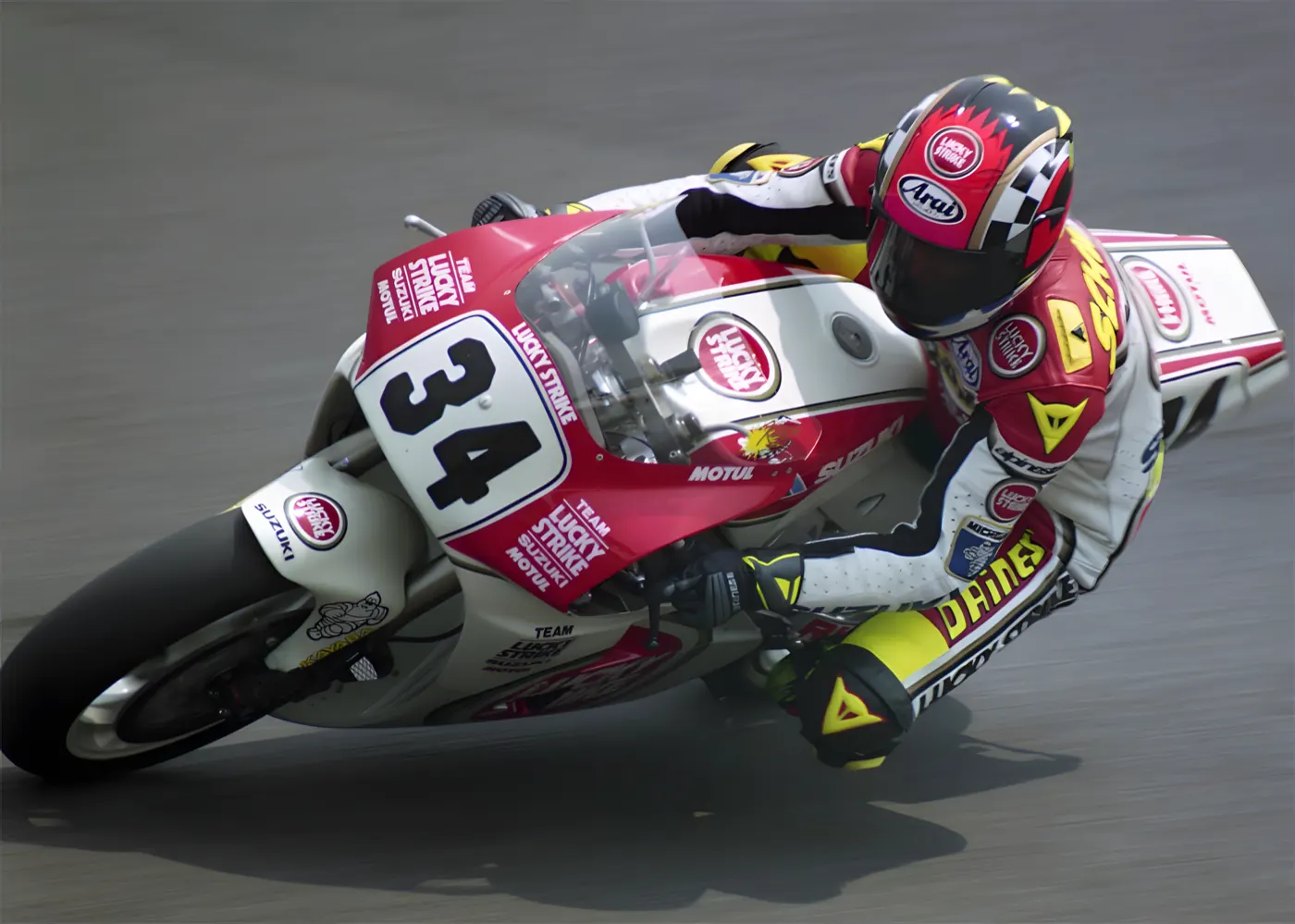
Kevin Schwantz didn't win the 1993 500cc World Championship because his Suzuki RGV500 was the fastest machine on the grid. In fact, the factory Hondas and Yamahas had more horsepower.
He didn't win because he had superior fitness—several competitors trained more consistently.
Schwantz won because he understood something fundamental about motorcycle racing that many riders overlook: the vast majority of racing performance happens between your ears, not underneath you.
Schwantz famous quote "Racing is 90% Between the Ears" Schwantz consistently emphasized throughout his career that racing success was predominantly mental—a perspective that aligned with his fierce, committed riding style through corners like Laguna Seca's Corkscrew and battles with rivals like Wayne Rainey.
What Schwantz understood intuitively through years of racing 500cc two-strokes—bikes that demanded absolute mental commitment—neuroscience research has now begun to validate with measurable data.
What Actually Happens in Your Brain During Peak Performance
The Flow State Discovery
The concept of "flow state" was first identified and studied by psychologist Mihaly Csikszentmihalyi in the 1970s. He observed that athletes, artists, and high performers across disciplines reported similar experiences during their best performances:
- Complete absorption in the task
- Distorted sense of time
- Loss of self-consciousness
- Sense of effortless control
- Intrinsic motivation and enjoyment
For decades, flow state was understood psychologically but not neurologically. We knew what it felt like, but not why it happened or how to reliably trigger it.
Transient Hypofrontality: When Your Prefrontal Cortex Takes a Break
Modern neuroscience research has revealed what's happening in the brain during flow states. One of the most significant discoveries is something called transient hypofrontality—a temporary reduction in activity in the prefrontal cortex.
Your prefrontal cortex handles executive functions like:
- Conscious decision-making and planning
- Self-criticism and social awareness
- Time perception and temporal processing
- Explicit memory formation
These functions are valuable for many aspects of life—but they're actually counterproductive for high-speed racing performance.
The Performance Paradox
When you're consciously thinking about your racing technique—analyzing your brake points, critiquing your lines, worrying about crashing—you're operating at the speed of conscious thought. Your prefrontal cortex becomes a bottleneck, slowing down the lightning-fast processing required for optimal performance.
When transient hypofrontality occurs, this bottleneck is temporarily removed. Your brain shifts into a mode where automatic, subconscious processes handle the complex motor tasks you've trained for thousands of times.
The Neurochemical Cocktail of Peak Performance
Flow states also involve significant changes in neurochemistry. Research has documented the involvement of several key neurotransmitters and neuromodulators:
Dopamine enhances focus, pattern recognition, and motivation. It's why flow states feel inherently rewarding—your brain's reward system is actively engaged.
Norepinephrine increases arousal, attention, and physiological readiness. Heart rate elevates, senses sharpen, and reaction times quicken.
Endorphins provide pain relief and create a sense of euphoria. This is why riders can maintain physical intensity for extended periods without fatigue disrupting performance.
Anandamide, often called the "bliss molecule," promotes lateral thinking and creativity. It's associated with the sudden insights and creative solutions that appear during flow—like seeing a passing opportunity that wasn't visible moments before.
Serotonin gets released after flow experiences, creating a sense of satisfaction and accomplishment that motivates return to that state.
Research from institutions like the Flow Research Collective and studies published in journals like Frontiers in Human Neuroscience have documented these neurochemical changes, though the exact mechanisms and magnitudes continue to be studied.
Why Two-Stroke 500s Were the Ultimate Flow State Training Ground
Kevin Schwantz's era of 500cc Grand Prix racing created near-perfect conditions for developing flow state capacity. The bikes were:
- Powerful and unpredictable: 180+ horsepower with on/off power delivery
- Mechanically simple: No traction control, no electronic aids
- Consequence-laden: Mistakes had immediate, often painful results
- Demand complete commitment: Hesitation or overthinking led to crashes
These conditions—high challenge, immediate feedback, clear goals, and full physical engagement—are precisely what flow state research has identified as key triggers for accessing peak performance states.
Riders like Schwantz, Wayne Rainey, Mick Doohan, and Eddie Lawson weren't just talented—they were operating in an environment that either forced them into flow states or eliminated them from competition.
Modern MotoGP bikes, with their sophisticated electronics managing power delivery and preventing crashes, allow riders to achieve high performance while remaining partially in conscious control. The bikes compensate for what the 500s demanded: absolute mental commitment.
The Camino Coaching Track Record: Evidence of Mental Performance Impact
Since 2016, Camino Coaching has specialized in flow state performance training for motorcycle racers, track day riders, and motorsport competitors across the UK and internationally. Over nine seasons of working with riders in British Superbikes, Junior GP, and MotoGP paddocks, we've documented consistent patterns:
Camino Coaching Performance Results
Based on 90 client reviews (4.9 out of 5)
Individual results vary. Past performance does not guarantee future results. Performance improvements depend on individual commitment, implementation, and racing context.
What do these numbers represent? Riders and drivers who've implemented systematic mental performance training—not generic motivational psychology, but evidence-based flow state conditioning protocols based on neuroscience research.
The common thread among clients who achieve breakthrough results isn't better equipment or superior natural talent. It's learning to access the mental states that championship-level performers like Kevin Schwantz accessed naturally through years of high-consequence racing.
What Modern Champions Understand About Mental Performance
Valentino Rossi: The Pre-Performance Ritual Master
Valentino Rossi, with 115 Grand Prix wins and nine World Championships across multiple classes, didn't become "The Doctor" through bike setup alone. Watch pre-race footage from his dominant years: while other riders obsessively check tire temperatures and make last-minute mechanical adjustments, Rossi performs consistent routines.
These aren't superstitions—they're neurological priming. Research suggests that pre-performance routines help athletes lower the threshold for entering flow states by creating familiar psychological and physiological conditions associated with past peak performances.
Rossi's overtakes—like the famous final-corner pass on Jorge Lorenzo at Catalunya 2009—weren't just brave. They were examples of a brain operating in a state where creative solutions emerge faster than conscious analysis could produce them.
Marc Márquez: When Perception and Correction Collapse
Marc Márquez has become legendary for his ability to save crashes that would sideline other riders. Multiple times per race weekend, Márquez catches slides that appear impossible to recover from.
This isn't superhuman reflexes—it's a brain operating in a state where the gap between perception and response effectively disappears. When flow state removes prefrontal cortex processing delays, athletes report that correction happens simultaneously with recognition. There's no conscious "I'm sliding, I need to correct" sequence—the correction is already occurring.
John McGuinness: The Isle of Man TT Memory Gap
John McGuinness, 26-time Isle of Man TT winner, has described a fascinating phenomenon in post-race interviews: during his fastest laps on the 37.73-mile course, he has limited explicit memory of certain sections.
"Barregarrow to Ramsey, I couldn't tell you what happened. I know I was fast because the timing said so, but it's like watching someone else's footage."
This isn't concerning—it's evidence of deep flow state. When the prefrontal cortex downregulates during transient hypofrontality, explicit memory formation reduces because conscious processing isn't engaged. The performance happens at an implicit, automatic level that doesn't create the same memory traces as conscious action.
The Challenge-Skill Balance: Why Goal Setting Matters
Flow state research consistently identifies one critical trigger: the challenge-skill balance. Flow occurs when the difficulty of a task slightly exceeds your current skill level—enough to demand full engagement, but not so much that anxiety takes over.
Too easy, and you slip into boredom or complacency. Too hard, and you trigger stress responses that prevent flow state access.
This is why proper goal setting is essential for mental performance training. Many riders either:
- Set goals too low ("just finish without crashing") leading to underperformance
- Set goals too high ("win the championship immediately") triggering anxiety
- Abandon personal goals entirely, tying their performance to external factors they can't control
Effective mental performance training involves identifying that "believable stretch"—a goal that feels within reach with maximum effort, keeping you in the flow channel where peak performance becomes accessible.
Why Most Riders Can't Access Flow Consistently
If flow states produce such dramatic performance benefits, why doesn't every rider access them consistently?
Several common blockers prevent flow state access:
Performance Anxiety: Fear of failure, comparison to competitors, or outcome-focused thinking keeps the prefrontal cortex active, preventing the transient hypofrontality necessary for flow.
Self-Consciousness: Internal monologue about how you're performing or what others are thinking maintains conscious processing rather than allowing subconscious execution.
Inadequate Technical Foundation: Flow requires skills automated to the point of unconscious competence. If you still need conscious attention for basic technique, flow state can't fully engage.
Poor Recovery: Flow states are neurochemically expensive. Without adequate sleep, nutrition, and recovery, your brain can't produce the neurotransmitters necessary for peak performance states.
Wrong Attentional Focus: Flow requires external focus (track, bike behavior, racing line) rather than internal focus (technique, fears, ego).
How Flow State Training Actually Works
At Camino Coaching, our approach to mental performance training is grounded in neuroscience research rather than generic sports psychology. The process involves:
Assessment and Baseline Identification
We start by identifying your current mental performance patterns: when and how you naturally access flow, what blocks it, and what your specific neurological baseline looks like during riding.
Flow Trigger Optimization
Based on research into flow state triggers, we customize protocols for your specific context—whether that's British Superbike racing, track days at Brands Hatch, or international competition.
Pre-Performance Priming
Like Rossi's rituals, we develop individualized routines that create the neurological and psychological conditions associated with your past flow experiences.
In-Session Flow Maintenance
Training to maintain flow under pressure, recover quickly from mistakes without spiraling into overthinking, and extend flow duration as sessions progress.
Post-Session Reinforcement
Debriefing processes that build conscious awareness of flow patterns without disrupting the subconscious execution that creates them.
The Reality About Mental Performance Training
Flow state training isn't magic, and it's not instant. It's systematic conditioning based on documented neuroscience research.
Our clients typically report initial flow state awareness within 2-4 weeks, with more consistent access developing over 8-12 weeks of implementation. Performance improvements vary significantly based on individual commitment, current skill level, and implementation consistency.
What we can say with confidence, based on nine seasons of documented results: riders who implement flow state training typically achieve performance improvements that mechanical upgrades alone don't deliver.
Discover Your Flow State Performance Potential
Kevin Schwantz understood what neuroscience now confirms: racing performance is predominantly mental. The question isn't whether flow states improve performance—the research has settled that question.
The question is: are you currently accessing your mental performance capacity, or leaving seconds per lap trapped in neurological patterns you've never learned to optimize?
Camino Coaching Flow State Assessment reveals:
- Your current flow state access patterns
- Specific blockers preventing peak performance
- Natural flow triggers you can leverage
- Personalized intervention protocols
- Realistic improvement timeline based on your baseline
With 9 seasons working with riders in British Superbikes, Junior GP, and MotoGP paddocks, we've developed assessment protocols that identify exactly where mental performance improvements will deliver the greatest lap time impact.
Results vary by individual. Performance improvements depend on commitment to implementation, current skill level, and racing context. Past client results do not guarantee future outcomes. Flow state training complements rather than replaces technical skill development and physical conditioning.
The Kevin Schwantz Legacy: Mental Performance as Competitive Advantage
Kevin Schwantz won the 1993 500cc World Championship not through superior equipment, but through mental commitment that allowed him to extract maximum performance from his Suzuki RGV500.
His aggressive, committed riding style—attacking corners like the Corkscrew at Laguna Seca while others braked conservatively—wasn't recklessness. It was a rider who'd learned to access mental states where commitment and performance converge.
Modern neuroscience research has begun to explain what champions like Schwantz understood intuitively: the vast majority of racing performance is indeed mental.
The only question remaining is whether you'll continue optimizing the mechanical 10% while ignoring the neurological 90%, or whether you're ready to systematically develop the mental performance capacity that separates championship contenders from mid-pack competitors.
Your bike is probably fast enough. Your body is likely fit enough. Is your brain optimized for peak performance?
Frequently Asked Questions About Flow State and Racing Performance
What is flow state in racing?
Flow state is a documented psychological and neurological state where athletes experience heightened focus, time distortion, and optimal performance. First systematically studied by psychologist Mihaly Csikszentmihalyi, flow involves specific neurological changes including reduced prefrontal cortex activity (transient hypofrontality) and enhanced neurochemical signaling. In racing, it's the state where you're not consciously thinking about technique—you're simply performing at your best.
Can flow state training actually improve lap times?
Research suggests flow state training can enhance athletic performance. Camino Coaching has documented 1,644 personal bests, 1,286 podium finishes, and 1,063 race wins since 2016, though individual results vary and past performance doesn't guarantee future results. Flow training complements rather than replaces technical skill development and physical conditioning.
How long does it take to see results from mental performance training?
Most clients report initial awareness of flow patterns within 2-4 weeks of beginning training, with more consistent flow state access developing over 8-12 weeks. Measurable performance improvements vary by individual—some riders report breakthrough performances within weeks, while others require longer systematic development. Unlike physical training which has predictable adaptation timelines, neurological performance training depends heavily on individual patterns and implementation consistency.
Is this just sports psychology or visualization?
Flow state training is based on neuroscience research rather than traditional sports psychology. While visualization and positive mindset can support performance, flow training specifically targets the neurological conditions (transient hypofrontality, neurochemical optimization, attentional focus) that create measurable brain state changes. It's not about feeling more confident—it's about creating the specific neurological conditions that produce peak performance.
Do I need to be an advanced rider for flow state training to work?
Flow state training is effective across skill levels, though the specific focus varies. Beginner riders need sufficient technical skill automation to allow flow state access—if you're still consciously thinking about basic controls, flow can't fully engage. Intermediate riders often benefit most dramatically because they've plateaued at conscious processing efficiency. Advanced riders use flow training to maintain consistency under pressure and extend peak performance duration.
Research References & Further Reading
This article is based on established neuroscience research and flow state studies:
- A Review on the Role of the Neuroscience of Flow States in the Modern World - NIH/PMC
- Physiological assessment of the psychological flow state using wearable devices - Nature Scientific Reports
- Neural Mechanisms and Benefits of Flow: A Meta Analysis - ResearchGate
- The brain in flow: A systematic review on the neural basis of the flow state - ScienceDirect
- Motor expertise modulates unconscious rather than conscious executive control - NIH/PMC
- Csikszentmihalyi, M. (1990). Flow: The Psychology of Optimal Experience. Harper & Row.
- Flow Research Collective - ongoing research into flow state optimization and athletic performance
About Craig Muirhead
Craig Muirhead is the founder of Camino Coaching and a specialist in flow state performance training for motorsport competitors. With nine seasons of experience working with riders in British Superbikes, Junior GP, and MotoGP paddocks, Craig applies evidence-based neuroscience research to help riders access peak mental performance states.
Since 2016, Camino Coaching has documented 1,644 personal bests, 1,286 podium finishes, and 1,063 race wins among clients implementing flow state training protocols. Craig's approach focuses on systematic neurological conditioning rather than generic motivational psychology, helping riders achieve breakthrough performances through evidence-based mental training.
Learn more about Craig and Camino Coaching →