The Neuroscience of Flow State: Why Your Conscious Mind Is Costing You Lap Time
How flow state takes time off every corner, and what's happening in the brain when it does
Are You As Fast As You Think?
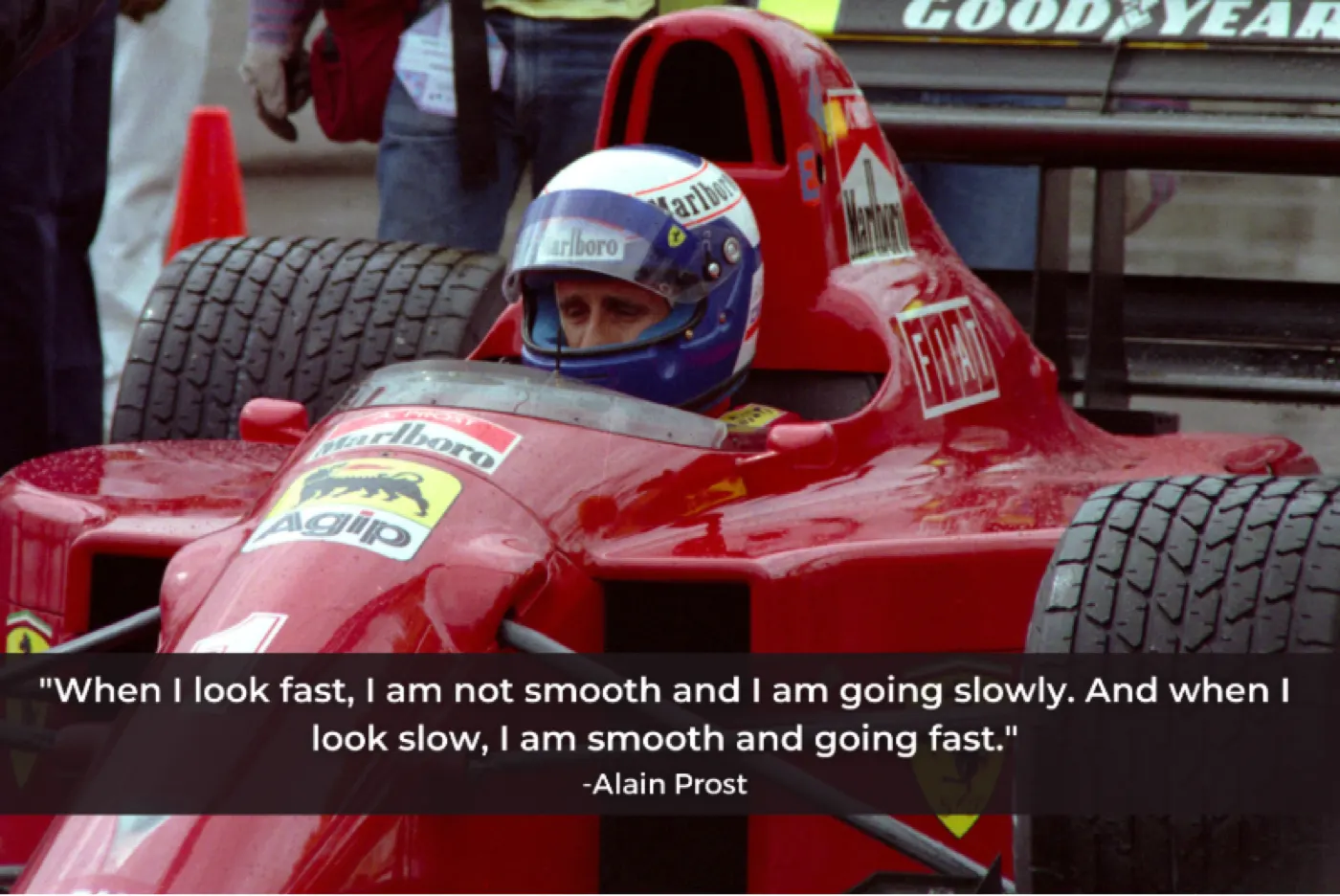
Alain Prost once said something that perfectly describes what really happens when we think we're going fast. When you're late on the brakes and hard on the steering, making the car squirm underneath you, it feels like it should be quick, right? But the timing sheets don't reflect it. You're actually going slower, making more mistakes than speed.
I see this constantly with drivers who overthink, landing themselves firmly in the "trying too hard" category. It's brutal to escape, too. The worse your performance gets, the harder you try. It's a downward spiral that feeds itself.
When you find yourself in this situation, you have to change the pattern of over-pushing. Instead, fall into a rhythm where you drive subconsciously, in flow. You might know it as The Zone.
Everything starts in the mind and then gets turned into reality by the body's movements. When you focus your thinking entirely on where you want to go, your mind makes it happen subconsciously without having to process thoughts about what to do.
When you're overthinking and trying too hard to go fast, your conscious brain takes control. That's the wrong part of the brain for performance. You actually go slower, because your conscious brain simply cannot process information fast enough.
The 110-Bit Bottleneck
Try this simple exercise. Time how long it takes you to say this sentence out loud:
Off the apex, start to straighten the wheel, feel for grip on the throttle, adjust steering, aim for the exit rumble strip, accelerate harder as the steering wheel straightens, counter steer, change gear, hard acceleration, adjust steering, use all of the track.
Drivers know this sequence well. But stop for a minute. How long did it take to say it out loud, describing the exit of just one corner?
When you're driving in that same trying-too-hard, process-by-process mode, you slow everything down to this level. You simply cannot think about what to do and also be quick. You need to be the action.
Your Conscious Mind Can Only Handle 110 Bits Per Second
Your conscious brain is your first filter on every piece of incoming information. I call it the drunken monkey. It jumps to conclusions, tries to predict the future, and gets it wrong constantly. The drunken monkey has limits. It tries to make sense of everything but always in an immediate and simplistic way.
The conscious mind processes 110 bits of information per second. That's it. If one person is talking to you, that takes up 60 bits per second. When another person starts talking at the same time, you immediately hit overload. You say, "Hold on, one at a time."
If you feel overloaded by two people talking, how on earth does that translate to your conscious mind being in charge during a race?
When you're trying to go faster, your 110 bits per second is already at capacity. Where's the brain space for knowing how and where to get that time advantage? You can feel bewildered how anyone can be a second (or more) faster than you are. You tell yourself, "If I go any faster, I'll crash."
This is a clear sign the drunken monkey is driving. You feel limited operating at 110 bits per second.
The Wizard Mind: 4 Billion Bits Per Second
To perform at your best, you need to move into the subconscious part of the brain. I call it the wizard mind. It operates at four billion bits of information per second.
Right now, as you're reading these words, it's running your nervous system, adjusting your temperature, seamlessly controlling all your organs to function at optimum levels for your ongoing health. It's the home of your imagination, creativity, and intuition. All these things happen without conscious thought. They're managed without you spending a nanosecond of effort. There are no limits in this subconscious, wizard state.
When you're driving well, you don't think about your driving. You don't think, "I need 50 bars of pressure on the brake pedal to bring me into the hairpin." You instinctively use the right amount of pressure. If you need a little more, you intuitively get the right amount.
To drive quickly, there's no time for conscious thought. You have to be instinctive and in a flow state to drive at your best. Flow is when everything clicks. Your car feels like it's on rails. It feels easy to be fast. Everything is manageable. Time gets distorted. It feels like you've been out on track for five minutes when you've actually been out for 40. It's the best place to be, where your performance skyrockets without any controlled or conscious effort.
The problem with flow is it can feel elusive. One day you're on fire and feeling untouchable. The next you can't find it at all. The frustration sets in, leaving you trying too hard once again, going slower, overthinking, and pushing the limits on what only the day before felt limitless.
What Actually Happens in Your Brain During Flow State
With the advent of EEG to measure brain activity over the last 25 years, we've started to learn what's going on when you're in the flow state. The adrenaline-fueled action-adventure athletes of the '90s became the first case studies. Anyone sponsored by RedBull, basically. Surfers, snowboarders, mountain bikers, skateboarders. They were identified as being the planet's best at getting into flow. Why? For most of them, if they didn't get into that subconscious flow state, they weren't going home that day.
Transient Hypofrontality: Shutting Down the Inner Critic
Flow is the result of a unique cocktail of chemicals released in the brain, which in turn creates a specific brainwave signature we'd typically only get in REM sleep. It also creates heightened brain processing, all combining to put you in flow.
One of the most fascinating discoveries is something called transient hypofrontality. This is temporary deactivation of the prefrontal cortex, the part of your brain responsible for executive function, self-referential thinking (your internal critic), and time perception.
Research using EEG and fMRI neuroimaging shows that during peak flow experiences, the dorsolateral prefrontal cortex shows significantly reduced activity. This isn't brain damage. It's strategic neural optimization.
By temporarily downregulating the prefrontal cortex, your brain eliminates the processing bottleneck of conscious thought, silences the internal critic that creates performance anxiety, distorts time perception (that 40-minute session that felt like 5 minutes), and frees up massive processing capacity for subconscious motor execution.
This is why flow feels effortless. You've literally shut down the part of your brain that creates the sensation of "trying."
The Neurochemical Cascade
Flow states are driven by a precise neurochemical sequence:
Dopamine creates intense focus, pattern recognition, and the motivation to continue performing. Enhanced dopaminergic transmission in the striatum is why flow feels intrinsically rewarding. Your brain's reward system gets amplified.
Norepinephrine sharpens attention, speeds reaction times, and enhances peripheral awareness. Critical for processing rapidly changing track conditions.
Endorphins suppress pain, allowing you to maintain physical intensity lap after lap without the distraction of fatigue signals.
Anandamide, often called the "bliss molecule," promotes lateral thinking and creative problem-solving. Finding that unexpected overtaking opportunity. It contributes to the euphoric quality of flow.
Serotonin gets released after flow experiences, creating the sense of accomplishment and contentment that makes you want to return to that state.
These neurochemical signatures are now measurable via wearable EEG devices and biochemical assays in real-time performance environments.
Brain Wave States: From Beta Overthinking to Theta-Gamma Coupling
EEG research over the past two decades reveals that flow states produce a distinctive neural signature.
When you're overthinking on track, you're locked in high beta waves (13-30 Hz). That's the frequency of conscious, analytical thinking, worry, doubt, and cognitive overload.
Flow produces something remarkable: theta waves (4-8 Hz) typically occurring in REM sleep or deep meditation, now happening during waking performance. When theta and gamma waves (30-100 Hz, high-level information processing) couple together, you get the "superhuman" processing speed characteristic of elite flow experiences.
Flow produces theta-gamma coupling while awake. A neural state typically reserved for dreams, now harnessed for peak performance.
The Challenge-Skill Sweet Spot
One of the biggest elements of flow is correct goal setting. In my work as a mindset performance coach over the past five years with drivers in British F4 and GB3, I've noticed that quite a lot have given up setting their own goals. Instead, they connect their goals to outside forces.
This is what I hear:
- "I want to see how I feel on the day first"
- "Let me see who else is racing this weekend"
- "I want to drive the track first, see how it feels, then I'll know what I'm capable of"
When I push them on why they dropped goal setting, they most often say it felt like added pressure. But for reaching a flow state, this is poison.
Flow State Principle: The Believability Stretch
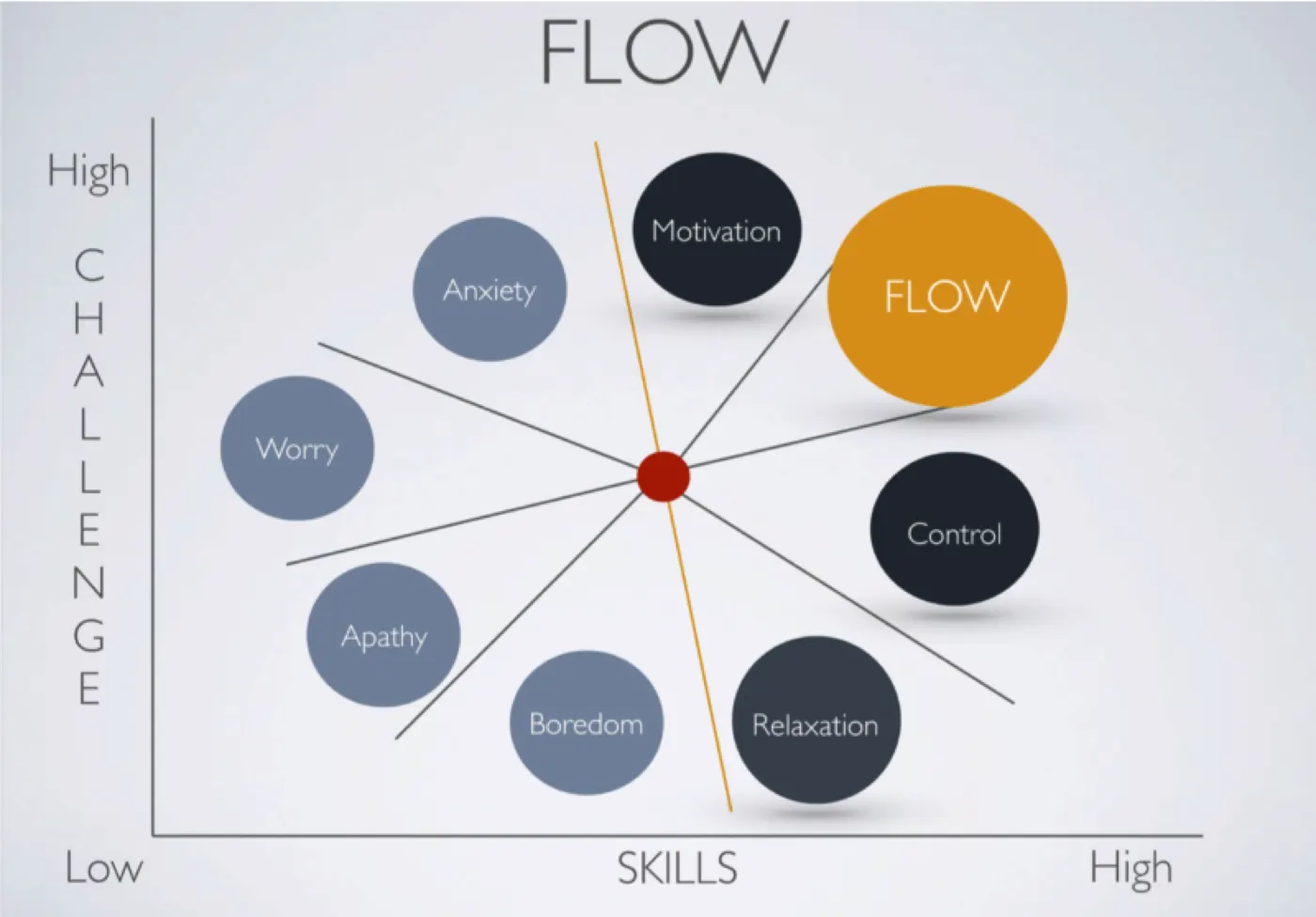
Flow is created by you working towards a meaningful goal and being focused long enough to achieve it. There's a sweet spot that gets you working at the right level each time to experience goal achievement.
The believability stretch is where you find that sweet spot. If the goal is too low, you meet immediate boredom or apathy as your skills are too high for the task. But if the goal is too high, you risk activating stress and anxiety, believing you're not up to the task.
For flow to be activated, we have to create your believable stretch goal. Something just out of reach, but if you work hard, you believe you can attain it. This very specific place keeps you focused and working repetitively in the flow sweet spot.
Why Most Drivers Can't Find Flow Consistently
Most have given up goal setting because they set too big a goal and became despondent when they didn't achieve it. The correct goals, plus other conditions and triggers, are the basis of my training with drivers. They take them from conscious thinking and zero flow, through to being a flow guru on track, tapping into the state each time they're behind the wheel.
If you've experienced flow but can't reliably access it, these neural disruptors are likely interfering:
Performance anxiety keeps the prefrontal cortex active, preventing transient hypofrontality. Fear of failure, comparison to competitors, or outcome-focused thinking blocks flow.
Self-consciousness maintains the internal monologue about how you're performing. "Am I looking smooth?" "What are people thinking?" This excessive prefrontal cortex activity is the exact opposite of what you need.
Inadequate preparation means you haven't mastered technique to the point of automaticity. If you need conscious control, you can't access flow. Flow requires a foundation of unconscious competence.
Poor recovery depletes the dopamine, norepinephrine, and other transmitters necessary for flow states. Flow is neurochemically expensive. Without adequate sleep, nutrition, and recovery, you can't produce the chemicals.
Wrong attentional focus keeps you internal rather than external. Flow requires focus on the task (track, car behaviour, racing line) rather than yourself (your technique, your fears, your ego).
How to Build Your Flow State Trigger System
Based on current neuroscience and five years of motorsport-specific flow coaching, there are now identified triggers and conditions needed to get into flow. With these in place, you can access flow more readily and repeatedly.
Pre-Session Flow Priming
Establish specific, believable stretch goals. Not outcome-focused ("win the race") but process-focused ("carry 5 kph more through Turn 7").
Create pre-performance routines that trigger alpha wave states. The bridge between conscious and subconscious.
Use breathwork to optimize arousal levels. 4-6 breaths per minute activates parasympathetic tone, calming the nervous system without losing alertness.
Visualize performance to pre-activate motor pathways without conscious verbalization. Your brain rehearses the movements without engaging the drunken monkey.
In-Session Flow Maintenance
External attentional anchors. Focus on track, car, racing line, not self.
Immediate feedback loops. Telemetry, split times, lap comparisons give your brain the rapid feedback it needs to sustain flow.
Challenge progression. Incremental difficulty increase as competence grows keeps you in the sweet spot.
Mistake recovery protocols. Rapidly return to flow after errors instead of spiralling into overthinking.
Post-Session Flow Reinforcement
Debrief without outcome fixation. What worked, not just raw results.
Identify flow moments for conscious recognition. Build awareness of what it feels like.
Recovery protocols to restore neurochemical reserves. Sleep, nutrition, active recovery.
Goal adjustment based on demonstrated capability. Recalibrate the believability stretch for next session.
The Measurable Reality of Flow States
This isn't subjective feel-good psychology. Flow states produce measurable performance improvements that have been studied extensively:
- Productivity increases of 400-500% in creativity and problem-solving tasks (McKinsey research)
- Learning acceleration of 200-500% faster skill acquisition (Flow Research Collective)
- Reaction time improvement of 8-10% faster responses during flow experiences
- Error reduction with significantly fewer mistakes despite increased speed
- Endurance enhancement where perceived exertion decreases while actual output maintains
In motorsport contexts, drivers consistently report 0.5-2 second lap time improvements when accessing flow, fewer costly mistakes during pressure situations, enhanced race craft and overtaking confidence, and improved consistency across session length.
These aren't anomalies. They're the predictable result of operating at 4 billion bits per second instead of 110.
From Conscious Override to Subconscious Mastery
Think about the first time you learned to drive. Where to look, how much brake pressure, when to turn in, how to feel for grip. Every action required conscious attention. It was exhausting, slow, and unnatural.
Now, when you drive to the shops, you navigate traffic, change gears, adjust to conditions, all while having a conversation or thinking about dinner. Those skills migrated from conscious processing to procedural memory stored in the basal ganglia and cerebellum.
Elite motorsport performance requires the same migration, but under extreme challenge. The difference is that driving to the shops doesn't require flow. Racing at the limit does.
You need to build technical skills through conscious, deliberate practice (prefrontal cortex-driven learning), migrate those skills to automatic processing (basal ganglia/cerebellum), then access flow states under pressure (transient hypofrontality while maintaining high-level execution).
This is the "expertise-and-release" model. Master the technique consciously, then release conscious control to access subconscious processing speed.
The Bottom Line
You can have the best car setup, the most powerful engine, the stickiest tires, and the most advanced telemetry. But if you're operating at 110 bits per second while your competitors are accessing 4 billion, you're bringing a calculator to a supercomputer fight.
The science is clear. Conscious processing is too slow for peak performance. Flow states produce measurable neurological optimization. Flow is not random, it's triggerable through specific conditions. Consistent flow access is trainable through evidence-based protocols.
The question isn't whether flow states improve performance. The data settled that question decades ago.
The question is: are you going to continue letting your conscious mind cost you lap time, or are you ready to systematically train flow state access?
Discover Your Flow State Profile
Want to know whether the wizard mind or the overthinking mind is driving your car?
Take the Camino Flow Profile assessment. It gives a quick snapshot of your current flow capacity and identifies what's blocking your access to peak performance.
- Your baseline flow state access (how often you actually get into flow)
- Primary blockers (anxiety, overthinking, poor goal-setting)
- Natural flow triggers (activities where you already experience flow)
- Personalized intervention points for rapid improvement
As a bonus, you'll receive our comprehensive video training module: "Quieting the Conscious Mind: The Neuroscience of Subconscious Performance." This science-backed introduction teaches you how to access flow states on demand.
If you're serious about finding that extra second (or three) the next time you're on track, it's not in your suspension settings or tire pressures. It's in the 86 billion neurons between your ears.
Sources & Research References
This analysis is based on peer-reviewed neuroscience research and motorsport psychology studies:
Flow State Neuroscience
- A Review on the Role of the Neuroscience of Flow States in the Modern World - NIH/PMC
- Physiological assessment of the psychological flow state using wearable devices - Nature Scientific Reports
- Neural Mechanisms and Benefits of Flow: A Meta Analysis - ResearchGate
Transient Hypofrontality Research
- The brain in flow: A systematic review on the neural basis of the flow state - ScienceDirect
- Enhancing flow states in neurodivergent individuals through transient hypofrontality - ACC Science
Motor Expertise & Unconscious Processing
- Motor expertise modulates unconscious rather than conscious executive control - NIH/PMC
- Motor expertise affects the unconscious processing of geometric forms - NIH/PMC
Additional Research Foundations
Flow state principles referenced in this article are based on research from:
- Flow Research Collective (Steven Kotler, PhD)
- Mihaly Csikszentmihalyi's foundational flow state research
- Contemporary neuroscience studies on peak performance psychology (2024-2025)
- Applied motorsport psychology and cognitive load theory
Frequently Asked Questions
What is transient hypofrontality and why does it matter for racing?
Transient hypofrontality is the temporary reduction of activity in the prefrontal cortex during flow states. This downregulation of conscious, analytical thinking frees up massive processing capacity for subconscious, automatic performance execution. In racing, it means your brain stops overthinking and starts responding at 4 billion bits per second instead of the conscious mind's 110 bits per second. This is why flow feels effortless and fast simultaneously.
Can anyone learn to access flow states consistently?
Yes. While some individuals have natural predispositions toward flow, the neuroscience is clear that flow states are triggered by specific, trainable conditions including clear goals, immediate feedback, and optimal challenge-skill balance. Most drivers begin experiencing more frequent flow states within 4-8 weeks of targeted training. Consistent, reliable flow access typically develops over 12-16 weeks of deliberate practice with proper motorsport mental coaching.
Why do I sometimes find flow easily and other times can't access it at all?
Flow requires specific neuropsychological conditions to occur. When you can't access it, common blockers include performance anxiety (keeping prefrontal cortex active), self-consciousness (internal focus instead of external), inadequate technical preparation (requiring conscious control), poor recovery (neurochemical depletion), or inappropriate goal setting (too easy causing boredom, too hard triggering anxiety). Identifying your specific blockers through flow profile assessment allows targeted intervention.
What's the difference between the "wizard mind" and "drunken monkey" you mention?
The "drunken monkey" is your conscious mind, processing just 110 bits of information per second through verbal, analytical thinking. It jumps to conclusions, creates doubt, and is far too slow for peak performance. The "wizard mind" is your subconscious system, processing 4 billion bits per second. It runs your entire nervous system automatically, controls complex movements without thought, and is where flow state performance lives. Racing at your best requires shifting control from the monkey to the wizard.
How does flow state training apply to business performance?
The same neurological mechanisms that create flow in motorsport apply to executive decision-making, creative problem-solving, and high-pressure business performance. Flow state training helps business leaders access peak cognitive performance, make better decisions under pressure, maintain focus during complex negotiations, and lead teams more effectively. Many executives use flow state coaching to enhance performance in high-stakes business environments.
About Craig Muirhead
Craig Muirhead is a 1:1 Neuro-Performance Coach at Camino Coaching with five years of experience working with drivers in British F4 and GB3. Since 2020, Camino Coaching has gone online, helping championship-level competitors worldwide optimize their mental performance through evidence-based, neuroscience-driven flow state training.
Craig's unique approach combines cutting-edge neuroscience research with practical, track-tested techniques that help drivers consistently access the flow state when it matters most. By focusing on the flow state, you can achieve faster times and peak performance.